
1. Expedition A3 Overview
1. Expedition A3 Overview
1.1 Component Description
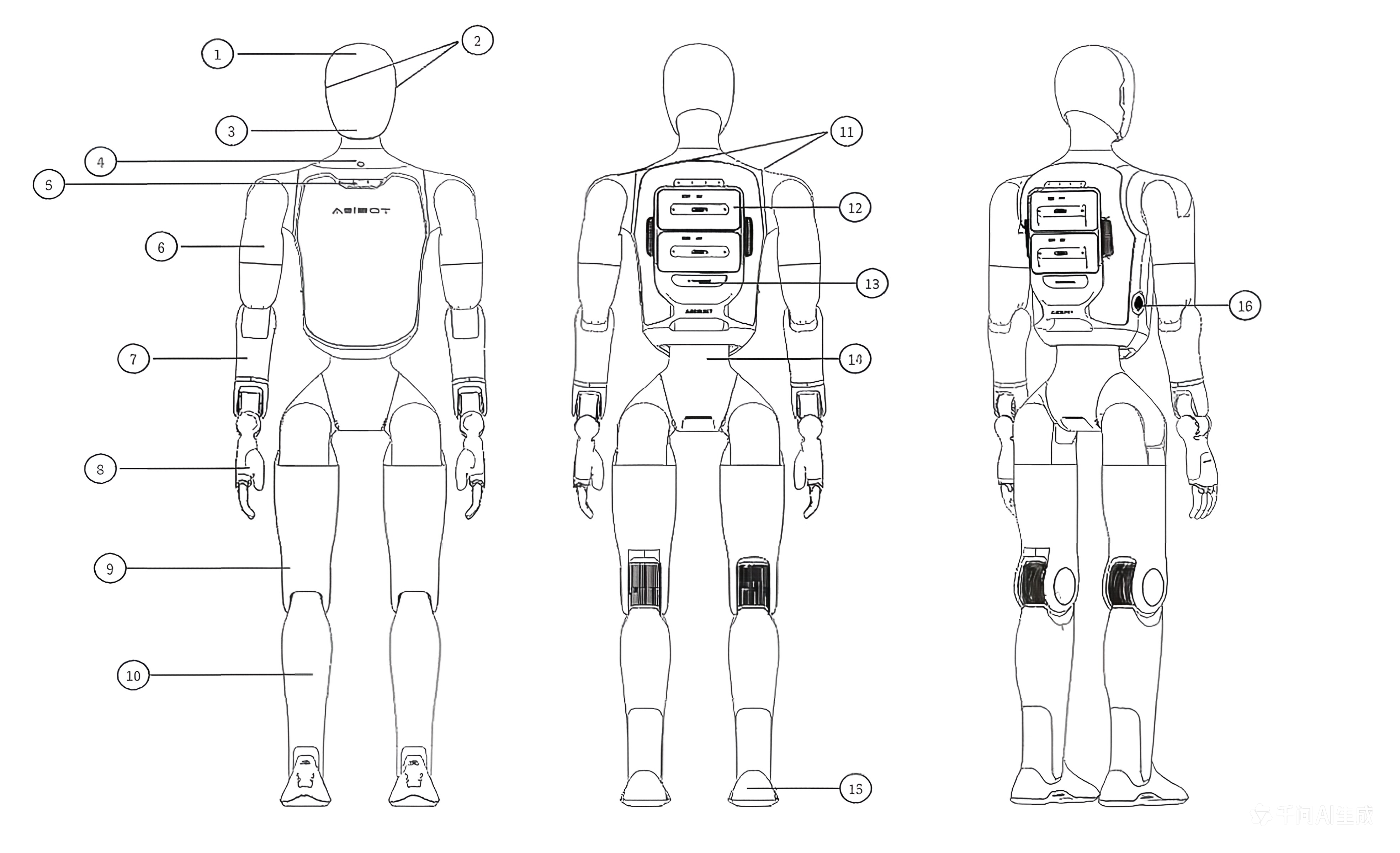
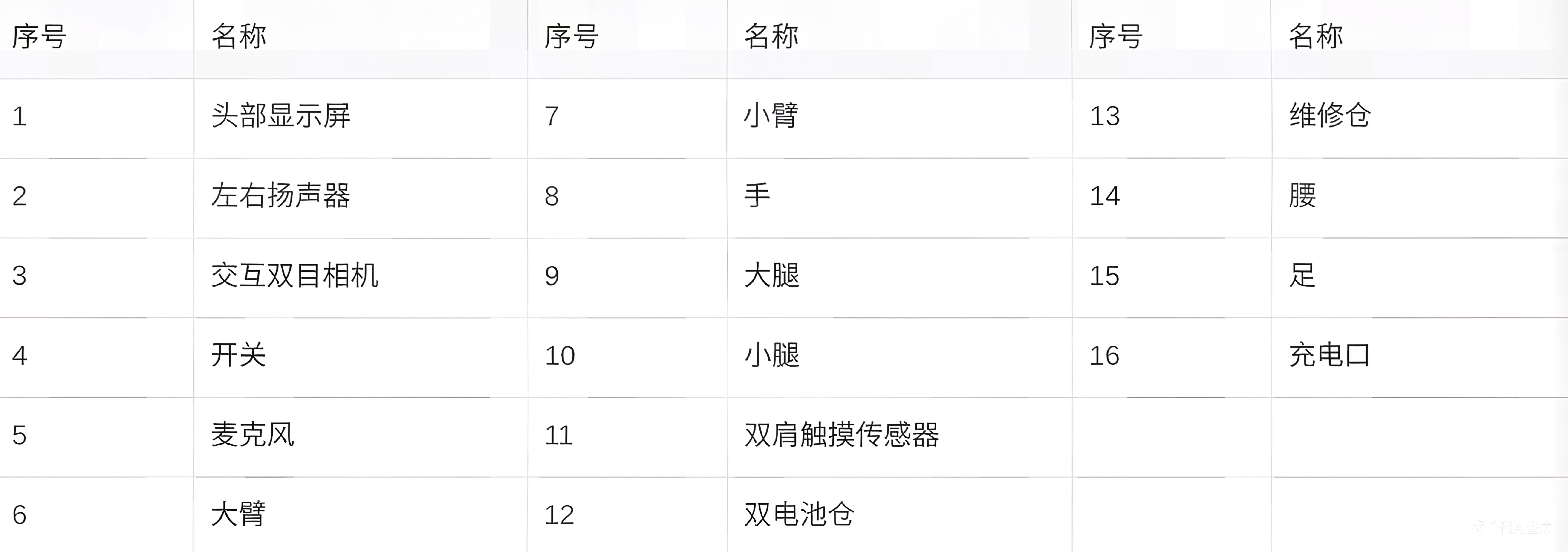
1.2 Robot Specifications
| Primary Category | Secondary Category | Item | Details |
|---|---|---|---|
| Basic Product Info | Height | 173cm | |
| Dimensions | 173(H)*52(W)*30(L)cm | ||
| Net Weight | ≈55kg | ||
| Active DOF | Neck 2dof, Dual Arms 7*2dof, Dual Legs 6*2dof, Waist 3dof, Dexterous Hand (optional: Agile 2026 (4*2dof), Professional 2026 (13*2dof)) 6*2dof | ||
| Product Features | Electrical Performance | Charging Voltage | 110V-220V |
| Battery Capacity | 1152Wh | ||
| Charging Time | ≤2H | ||
| Endurance Time | 10H | ||
| Environmental Adaptability | Working Temperature & Humidity | Ambient temperature -10°C ~ 45°C, relative humidity 10% ~ 90%, no condensation | |
| Storage Temperature & Humidity | -20°C ~ 70°C, relative humidity 10% ~ 90%, no condensation | ||
| IP Rating | Joint module: IP5X | ||
| Site Adaptability | Minimum Passage Width | 600mm (sideways), 900mm (front) | |
| Maximum Obstacle Height | 25cm | ||
| Maximum Slope | Can move omnidirectionally on a 15° slope and can park at any orientation on a 15° slope | ||
| Product Capability | Perception Capability | Environmental Perception | Dual binocular cameras on head |
| Navigation Capability | Positioning Accuracy | ±10cm , ±10° | |
| Navigation & Obstacle Avoidance | Supports real-time autonomous navigation and obstacle avoidance | ||
| Mobility | Maximum Speed | 1.2m/s | |
| Movement Modes | Supports forward, left turn, right turn | ||
| IoT Capability | Communication Capability | WiFi, Bluetooth, 4G/5G mobile network | |
| Typical Arm Parameters | Rated Load per Arm | 5kg | |
| End-effector Speed | Loaded: 1m/s, Unloaded: 3m/s | ||
| Arm Workspace | J1(Shoulder pitch): ±170° | ||
| J2(Shoulder roll): ±91° | |||
| J3(Shoulder yaw): ±160° | |||
| J4(Elbow pitch): -60°~140° | |||
| J5(Wrist roll): ±33° | |||
| J6(Wrist pitch): ±93° | |||
| J7(Wrist yaw): ±160° | |||
| Typical Leg Parameters | Leg Workspace (approximate) | J1(Hip roll): -60~100° | |
| J2(Hip yaw): ±158° | |||
| J3(Hip pitch): -168°~154° | |||
| J4(Knee pitch): -10°~140° | |||
| J5(Ankle pitch): -52°~30° | |||
| J6(Ankle roll): ±20° | |||
| Typical Head Parameters | Head Workspace | Pitch joint: -15°~30° | |
| Rotation joint: ±90° | |||
| Typical Waist Parameters | Waist Workspace | J1(Waist roll): ±20° | |
| J2(Waist yaw): ±150° | |||
| J3(Waist pitch): ±30° |
1.3 Sensor and Controller Specifications
The robot system consists of two core computing units:
MDU (Main Data Unit): Based on the RK3588 industrial control platform, responsible for high-performance computing and multi-device expansion.
HDU (Human-machine Data Unit): Based on the RK3588S2 platform, mainly responsible for human-machine interaction and lightweight computing tasks.
For RK3588 series specifications, refer to the Rockchip official website. The following table lists the basic hardware parameters of the controllers and sensors:
| Controller | Hardware Type | Specifications |
|---|---|---|
| MDU | CPU | 8-core ARM big.LITTLE (4×A76 + 4×A55), up to 2.3GHz, with L3 cache |
| Memory | 16GB | |
| Disk Capacity | 256GB | |
| HDU | CPU | 8-core ARM big.LITTLE architecture (4×A76 + 4×A55), up to 2.3GHz |
| Memory | 16GB | |
| Disk Capacity | 128GB | |
| Binocular Camera | Resolution: 1920*1536 Frame rate: 30fps Data format: yuv422, mjpeg |
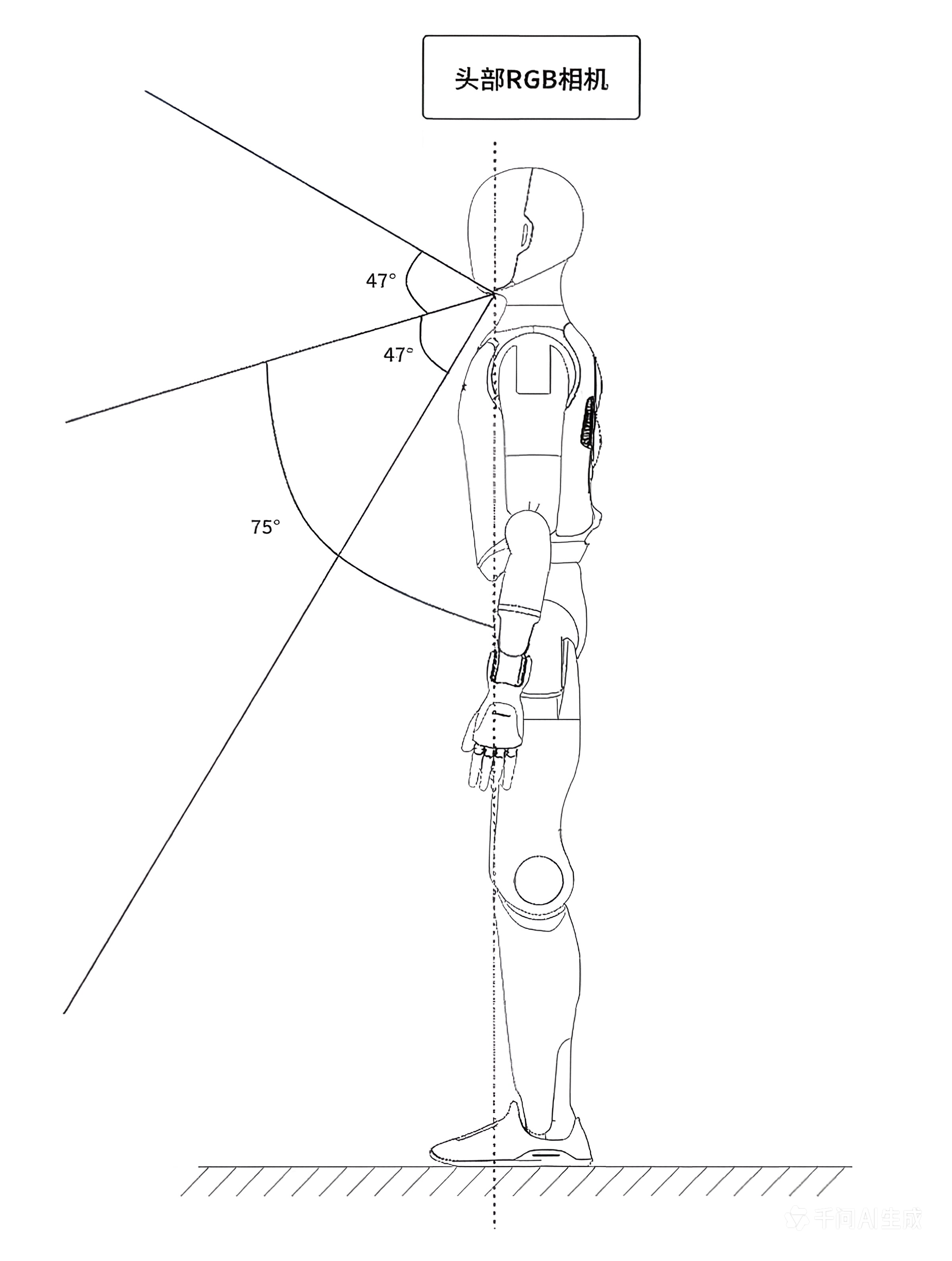
1.4 Camera Field of View
The Expedition A3 is equipped with an interactive binocular camera on its head, supporting visual recognition and response in human-machine interaction scenarios. The specific field of view is as follows:
1.5 Network Topology
Software network topology diagram:
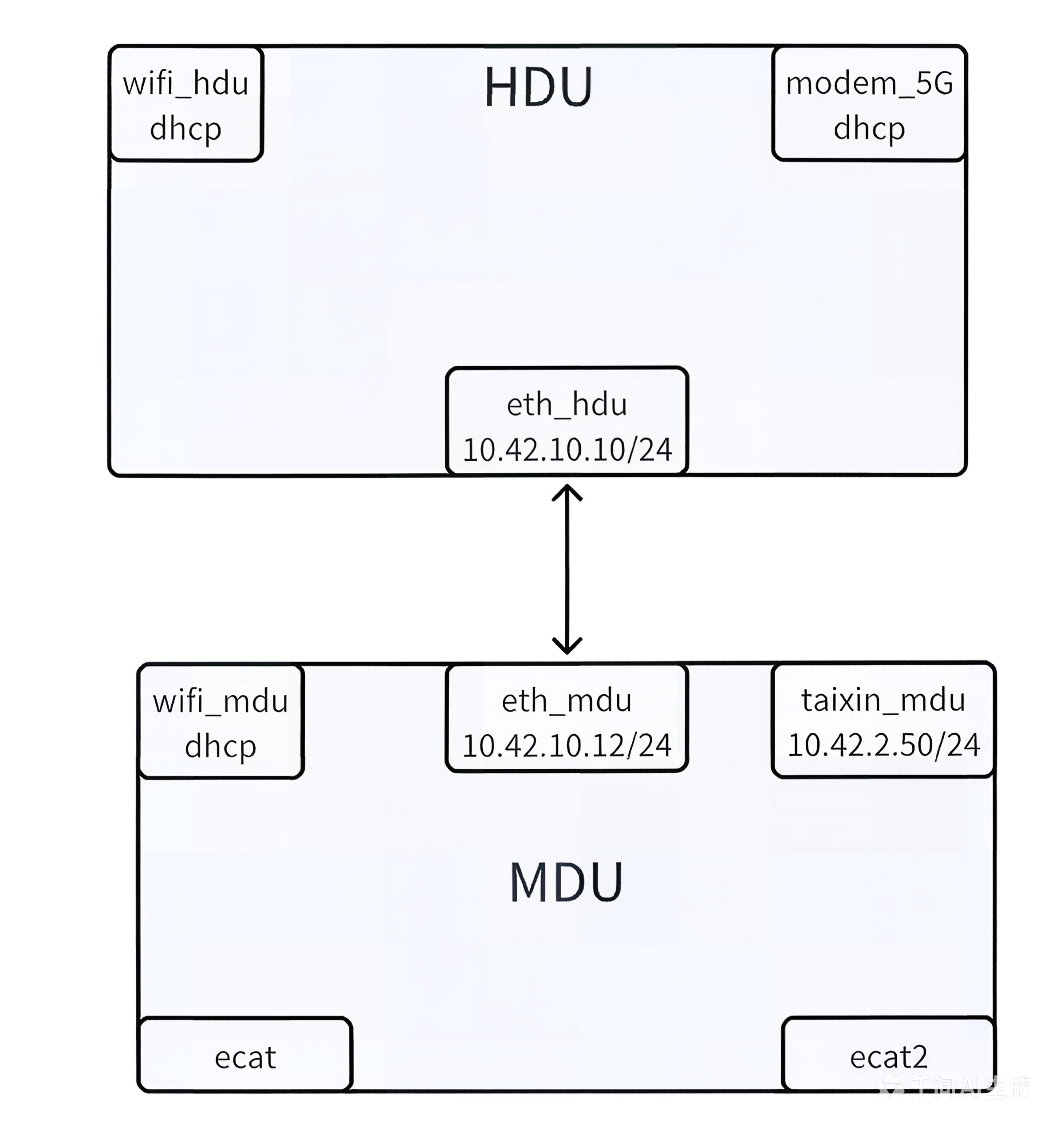
The HDU connects to the external network via WiFi and forms the robot's internal core network with the MDU through eth_hdu (10.42.10.x). 5G serves as a backup link, allowing connection to the external network via 5G when WiFi is unavailable.
Note: The robot's debug bay network port is currently disabled and is an invalid port. Type-A is for debug testing only, and the Type-C port is for remote controller charging only; do not connect other devices.